Well, we come to the end of a shortened market week, and have to say, Yesterday threw us some surprises. One surprised figure was the number of jobs on employers' payrolls fell by 467,000 in June, which was significantly worse than analysts had expected. The unemployment rate rose to 9.5. This really throws a dagger into the hoped of a recovery in the 3rd and forth quarters of the year. I still think their is hope, but it is possible we will have to wait till Quarter 1 of 2010 to see an end to the recession.
Below is the usual list of economic data to be released next week. Unlike this week, there is not all that much data becoming available, but the usual claims for unemployment should be interesting.
Jul 6 10:00 AM ISM Services Jun
Jul 8 10:30 AM Crude Inventories
Jul 8 3:00 PM Consumer Credit May
Jul 9 8:30 AM Initial Claims 07/04
Jul 9 10:00 AM Wholesale Inventories May
Jul 10 8:30 AM Export Prices ex-ag. Jun
Jul 10 8:30 AM Import Prices ex-oil Jun
Jul 10 8:30 AM Trade Balance May
Jul 10 9:55 AM Mich Sentiment-Prel Jul
There really are not too many earnings reports being released either, next week. Here are a couple of the highlights though.
Tuesday - Ruby Tuesday
Wednesday - Pepsi
Thursday - Chevron
Showing posts with label interest rates. Show all posts
Showing posts with label interest rates. Show all posts
Friday, July 3, 2009

Wednesday, June 24, 2009
Federal Reserve Interest Rate Move?
Today is a big one for those who follow the moves of the Federal Reserve. Today at 2:15 PM EST they will decide on the status of current rates. I'm standing pretty confident though that there will be no changes to the current rates this time around. They are currently hovering in the 0% - 0.5% range and will likely remain there for a couple more months.
The Federal Reserve also has to consider their Treasury buying activities. The current plan to buy treasuries will run it's course come September. Will they extend this plan? Another thing to consider is long term inflation. Ben Bernanke seems to think that he can leave rates low for some time before having to worry about the pending inflation, which will come eventually. In My opinion the Fed is stuck between a rock and a hard place with their interest rate options. They know that the eventual rise of rates will be needed to counter inflation, but, also know that if they begin raising rates now, it will likely send the stock market down, possibly weakening consumer sentiment and slowing the possible economic turnaround as a whole.
“They have to be really careful,” said Christopher Low, the chief economist at FTN Financial in New York City. “They may not be forceful because they are worried about how the market will react,” he said. “The Fed needs to communicate they are aware of the shift in inflation expectations and they take inflation fighting seriously.”
I expect them to at least keep rates at the current level for another few months, possibly starting to raise them sometime in the 4th quarter of this year. Although the initial reaction from the markets of a rate increase may be a sell off of equities, longer term it will show the markets a recovery is in the works, giving them more confidence.
The Federal Reserve also has to consider their Treasury buying activities. The current plan to buy treasuries will run it's course come September. Will they extend this plan? Another thing to consider is long term inflation. Ben Bernanke seems to think that he can leave rates low for some time before having to worry about the pending inflation, which will come eventually. In My opinion the Fed is stuck between a rock and a hard place with their interest rate options. They know that the eventual rise of rates will be needed to counter inflation, but, also know that if they begin raising rates now, it will likely send the stock market down, possibly weakening consumer sentiment and slowing the possible economic turnaround as a whole.
“They have to be really careful,” said Christopher Low, the chief economist at FTN Financial in New York City. “They may not be forceful because they are worried about how the market will react,” he said. “The Fed needs to communicate they are aware of the shift in inflation expectations and they take inflation fighting seriously.”
I expect them to at least keep rates at the current level for another few months, possibly starting to raise them sometime in the 4th quarter of this year. Although the initial reaction from the markets of a rate increase may be a sell off of equities, longer term it will show the markets a recovery is in the works, giving them more confidence.
Sunday, June 7, 2009
Mortgage Interest Rate History
Well It's Monday so I thought we'd do another chart here, as I love looking at charts filled with lots of good information. The chart/graph below shows the various types of mortgage rates for the last 17 years:

Mortgage Rate History
I'm concentrating on the Red and orange lines, which are the 30 year and 15 year fixed rate mortgage rates. If you just take a quick glance at them, you can clearly see that we are at the lowest rates, by far, in the last 17 years. In my opinion, if you can refinance your mortgage, this IS the time to do it. Don't wait. I personally feel this will be just about the lowest rates many will see in perhaps their lifetime. We are about 40% lower the the highs we saw in the early 1990's, and probably won't be going down any further from here.
Buy Outright, or Take a Mortgage?
Many people who have the cash to buy a home will buy the home outright. Sure, this will give you the piece of mind, knowing you owe nothing, and will likely never have a worry in the world about your home's affordability, however, it may not be the smartest move right now. If you can get a mortgage for 5%, it may be best to take it regardless if you can buy the home outright or not. Why? Inflation will likely go up quite a bit in the coming years. The FED will likely raise interest rates by quite a but over the next few years, meaning bank Certificates of deposits could possibly be paying an interest rate, in 2-3 years, higher then what you can take a mortgage out for today. f you can borrow $500,000 at 5% and get a CD or bond for 6%, you are making a cool $5000 a year profit. Just something to think about.
Conclusion
In my opinion, we have clearly struck a floor with interest rates, and anyone who hesitates on refinancing now, will likely regret it pretty soon.
Tuesday, June 2, 2009
Historic PE Ratios Compared to Interest Rates
I don't have all that much news to bring to you all today so I thought I'd take a look at another chart. Below is graph of Interest rates vs the PE Ratios (Price to earning ratios of the S & P 500) over the last 120 years in the United States:
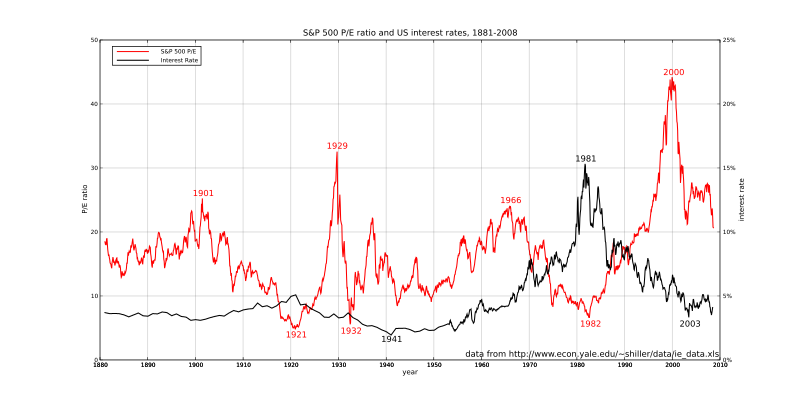
Like I said before I love looking at graphs and charts because they can tell you more than an entire 10 page essay could in just a few seconds. As you can see, we are currently at a pretty high average PE ratio, but having said this, it is so much lower then it was just a few years ago. You also must account for the fact that there is now optimism in growth, so a higher than average PE ratio is not all that bad. The current graph, however, leads me to believe that we may see a leveling off of the Dow at around 9000-9200, where it may stay and hover around for some time until better earning reports come out.
For those of you not familiar with PE ratios, it basically is the return a stock has over a year. If you have a PE ratio of 20, that means it will take the company 20 years to make a profit equal to it's current share price. Divide 100 by the PE ratio and you will get the rate of return the company is making. For instance 100/20 = 5, which means investing in the stock will provide a 5% annual return. Looking at the chart above you can see that in 1982, PE ratios were low, while interest rates were high. Is is because people could make a ton of interest just buying bonds, so why invest into stocks that have a yield lower then bonds do, at greater risk.
It should be interesting to see, how inflation could hamper the recovery of the US stock market should it go up by more then a few basis points.
Subscribe to:
Posts (Atom)
